How to Choose a Pneumatic Gripper
Jun. 17, 2026
Selecting the right pneumatic gripper is a critical decision in designing an efficient automated system. To ensure your production line operates smoothly without mechanical failure, you must evaluate specific workpiece parameters and mechanical forces.
This comprehensive guide—compiled with insights from Joey Ding, Chief Designer at FOUK Grippers—details the essential steps for choosing the perfect gripper for your application.
1:Choose the Gripper Type Based on Workpiece Shape
FOUK Grippers offers three primary series to adapt to various workpiece geometry needs: the FR Series (two-finger parallel pneumatic gripper), the FZ Series (3-finger pneumatic gripper), and a 4-finger pneumatic gripper series.
When evaluating your workpiece shape, apply these rules of thumb:
3-Finger Grippers: When you need to achieve centered gripping on circular, ring-shaped, or bar-stock workpieces, a three-finger configuration is typically preferred.
2-Finger Parallel Grippers: For the vast majority of other handling scenarios, a standard parallel pneumatic gripper is better suited to satisfy your clamping requirements.

(fouk 3 finger pneumatic gripper working image)
2:Pre-select the Model Based on Workpiece Weight
FOUK’s product manual provides structured catalog pages to help you perform an initial model filtering based on the total mass of the object being handled. Additionally, FOUK offers a specialized long-stroke pneumatic gripper series to accommodate components requiring higher dimensional compatibility.
Stroke Calculation and Clamping Margins
Once a model is shortlisted by weight, you must verify its stroke compatibility to ensure it can successfully handle varying workpiece lengths.
Consider this practical sizing example:

(square workpieces )
Scenario: You need to grip square workpieces (As shown in the figure) with lengths (L) of 20 mm, 30 mm, and 45 mm, weighing 10 kg.
Initial Options: Based on the 10 kg weight, you might look at the FR72-192-M and FR57-151-S, which offer strokes of 16 mm and 6 mm respectively.
Calculation: The raw dimensional variance between your workpieces requires an opening/closing span of roughly 25 mm. However, because the jaws must open fully to clear the part during placement and retain a tight safety margin when closed, you must add extra millimeters to the stroke layout(As shown in the figure) .
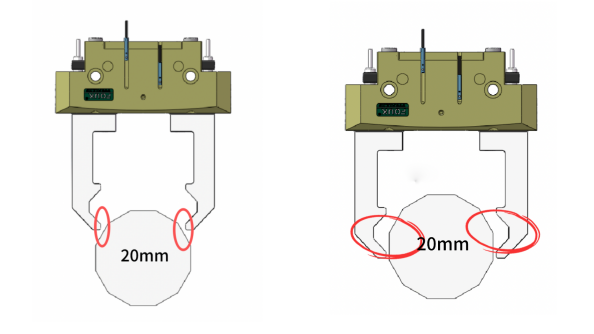
Conclusion: This calls for a total jaw movement range of 30 mm, equating to roughly 15 mm of stroke per side. Therefore, the FR72-192-M (with its 16 mm stroke) is the correct choice, while the 6 mm stroke model falls short. Following these precise steps ensures your chosen gripper successfully matches both your structural weight load and physical operating conditions.
Expert Advice
To prevent long-term mechanical degradation, keep these two advanced engineering factors in mind:
Addressing Extra-Long Stroke Requirements
If your application demands an exceptionally long stroke—for instance, handling a 10 kg workpiece that requires a wide 100 mm stroke range—a standard gripper will not suffice. In these cases, you can either custom-design adjustable finger attachments or utilize the ZM Quick-Change Finger Series. This allows the gripper to easily swap out customized fingers for different part sizes, achieving excellent product compatibility.
Managing Overturning Moments and Finger Length
Every gripper specification sheet includes a critical parameter known as the "maximum allowable gripping distance".

The Problem: When custom gripper fingers are designed too long and combined with high pneumatic gripping forces, they generate a massive overturning moment (tilting torque). This leverage effect causes the internal mechanisms to bind, resulting in gripper jamming or hesitation.
The Mechanics: When clamping forces act close to the internal guide slider, opening and closing actions remain completely smooth. However, when forces are exerted further out on an elongated finger, the jaws may fail to move entirely, even under high pressure. Empirical testing confirms a universal rule: the longer the custom fingers, the smaller the effective gripping force becomes.

The Solution: Engineering teams should keep gripper finger lengths as short as physically possible. If your process footprint dictates a finger length that overloads the gripper's rated moment capacity, you must size up to a gripper model that is one or two sizes larger to handle the torque.
Recommended Products by Joey Ding:
FOUK FR / FZ / TF Series Grippers
ZM Quick-Change Finger Series


